
A book by Asim Javed
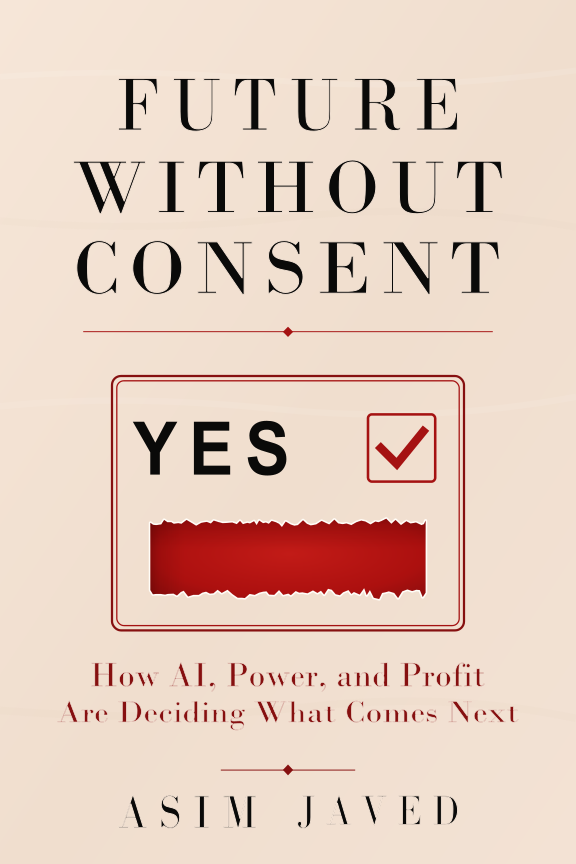
Future Without Consent
How AI, Power, and Profit are deciding what comes next. Here's the research behind the book, shared in real time.
 Coming Soon
0
Events tracked
0
Years of AI history
0
Topics
0
Categories
Latest Events
The most recent developments tracked by our research pipeline.
September 20, 2026
Alibaba shrinks its image model to run on a home GPU - Research License only
A serious image generator that fits on a gaming graphics card is now a free download, with a catch in the fine print. Alibaba's Qwen team released Qwen-Image-2.1 on September 20, 2026, cutting the visual generator from roughly 20 billion parameters to 7 billion while adding native transparent (RGBA) output, editing with up to ten reference images and 2K resolution, with weights on Hugging Face, ModelScope and GitHub and same-day support in ComfyUI, Diffusers, vLLM-Omni and SGLang. Unlike earlier Qwen-Image releases under Apache 2.0, this one ships under a research-only license that bars commercial use without a separate grant from Alibaba, and its benchmark claims come from Qwen's own scoring chart.
SourceSeptember 20, 2026
Tesla locks in Chinese suppliers for 1000s of humanoid robots per month
The parts needed to build humanoid robots in bulk now have signed-up factories behind them. Tesla's robotics team visited Ningbo in China's Zhejiang province in mid September and promoted three existing car-parts suppliers, Tuopu Group (joints and frames), Ningbo Joyson Electronic (sensors) and Zhejiang Sanhua Intelligent Controls (cooling), to certified mass-production partners, reportedly with an opening order of about 5,000 units. Tesla has converted its Fremont Model S and X floor space into an Optimus line aiming at a million robots a year, with a bigger plant at its Texas factory and commercial sales still targeted for the second half of 2027.
SourceSeptember 18, 2026
California orders work on an AI kill switch
California is now formally studying whether frontier AI companies should be required to build an emergency shutoff for their own models. Governor Gavin Newsom signed an executive order on September 18, 2026 directing the Government Operations Agency and the Office of Emergency Services to convene outside experts who have two months to recommend stronger state AI safety laws, including a "kill switch," independently written safety plans for frontier developers, and disclosure of loss-of-control incidents. The order also pulls forward the state's AI auditor registry and independent verification program from January 2029 to December 2027, accelerating SB 813 and AB 1405, which Newsom signed earlier in the month.
SourceSeptember 18, 2026
Chatbot error nearly triggered US boarding of Chinese ship
A US military operation to board a Chinese ship was called off at the last minute because the intelligence behind it came from a chatbot that got the cargo wrong. CNN reporters Katie Bo Lillis and Zachary Cohen found that during this spring's US war with Iran, a Special Operations Command analyst used an AI tool to assess ship manifest intelligence, and the tool wrongly concluded the vessel carried nuclear weapons components. Armed personnel were preparing to board and planes were in the air when officials discovered the report was AI-assisted and false. One source said it "almost started a war." SOCOM Pacific and the Pentagon declined to comment.
SourceSeptember 17, 2026
White House drafts plan to hatch cyber startups
The US government is thinking about becoming a startup founder itself, spinning up hacking and defense companies whose customers would be federal agencies. Bloomberg reporters Patrick Howell O'Neill and Maggie Eastland report that the White House Office of the National Cyber Director has drafted an executive order for a "cyber foundry" that would create new firms and pull in private venture capital, modeled on Israel's tie between its military cyber unit and companies like Wiz, Check Point and Palo Alto Networks. The same draft would fold scattered federal cyber training into one academy, after CISA lost more than a third of its staff last year.
SourceSeptember 17, 2026
Microsoft's own scientist called AI scraping mass theft
It turns out some of the people building these systems described the training data grab in blunter terms than the critics did. Newly unredacted filings in The New York Times' copyright case against OpenAI and Microsoft show Microsoft's Director of Applied Science, Brent Hecht, writing in a 2023 internal memo that AI scraping was "the largest theft of labor in human history," and later presenting company data showing Copilot's chat answers cut clicks through to nytimes.com by up to 93% compared with ordinary Bing search. OpenAI's Nick Turley is quoted calling such products an "existential threat" to publishers, while CEO Satya Nadella testified he would have made OpenAI retrain its models had he known paywalled material was taken.
Source